How much is politics hampering delivery of aid to Syria? | Inside Story
posted by Forhad @ February 10, 2023
0 Comments

posted by Forhad @ February 10, 2023
0 Comments
posted by Forhad @ February 10, 2023
0 Comments
posted by Forhad @ February 10, 2023
0 Comments
posted by Forhad @ February 10, 2023
0 Comments
posted by Forhad @ February 10, 2023
0 Comments
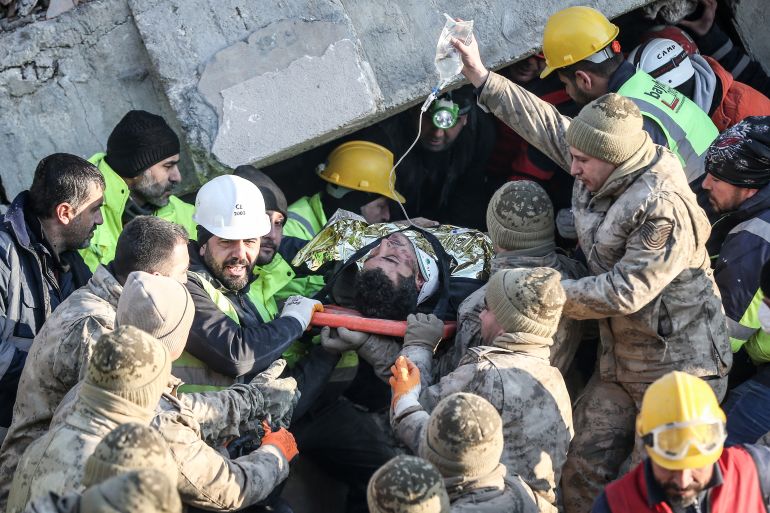
Operations continued on Friday, but hopes of finding people alive are fading away.

Still, there is room for some hope amid the devastation. An 18-month-old baby and her family members were pulled alive from beneath the ruins of a collapsed building in Hatay’s Antakya district in southern Turkey, after being trapped for 96 hours, the Anadolu Agency reported.
Here is a roundup of what you need to know on day five of the rescue effort:
The death toll from the Turkey-Syria earthquakes, which Turkish President Recep Tayyip Erdogan has called “the disaster of the century”, has passed 21,500.
President Fuat Oktay, while at least 3,377 are known to have died in Syria.By comparison, 18,400 died in the 2011 earthquake off Fukushima, Japan, which triggered a tsunami and an estimated 18,000 people died in a quake that hit Izmit, Turkey, in 1999.
Tens of thousands were also injured in Monday’s disaster and many tens of thousands have been left homeless.

The winter weather and damage to roads and airports have hampered the rescue response. Some in Turkey have complained that the government was slow to respond – a perception that could hurt Erdogan at a time when he faces a tough battle for re-election in May.
The president has been visiting affected cities over the last two days.
Turkey’s disaster management agency said more than 110,000 rescue personnel would be taking part in the effort with the assistance of more than 5,500 vehicles, including tractors, cranes, bulldozers and excavators. The foreign ministry said 95 countries have offered help.
Even though experts say trapped people could survive for a week or more, the chances of finding survivors in the freezing temperatures are dimming, with emergency crews now starting to shift the focus to demolishing dangerously unstable structures.
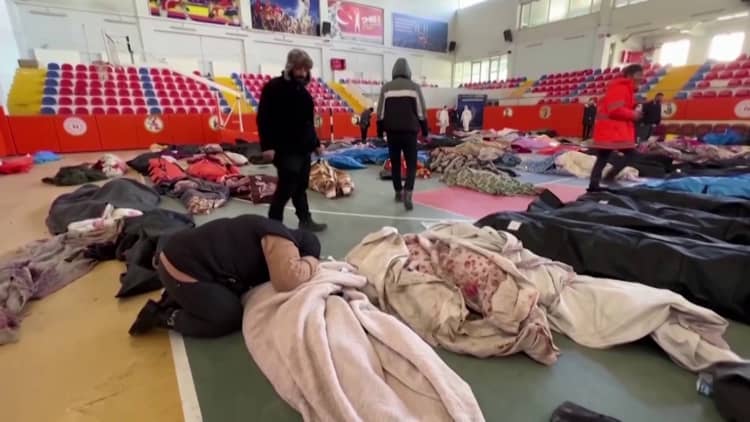
In Kahramanmaras, a sports hall the size of a basketball court was serving as a makeshift morgue to accommodate and identify bodies.
In the Turkish city of Antakya, dozens scrambled for aid in front of a truck distributing children’s coats and other supplies. One survivor, Ahmet Tokgoz, called for the government to evacuate people from the region.
Many of those who have lost their homes found shelter in tents, stadiums and other temporary accommodation, but others have slept outdoors.

The United States on Thursday announced an initial $85m package in emergency relief for the two affected countries, and is also temporarily lifting some of its Syria-related sanctions, hoping to help aid move as quickly as possible to those affected.
Meanwhile, the World Bank has announced $1.78bn in aid to Turkey to help with relief and recovery efforts.
United Nations chief Antonio Guterres is calling on the international community to provide more money for Turkey and Syria, and widen access for aid to reach the earthquake-stricken parts of Syria.
Providing aid to opposition-controlled areas in northwestern Syria has proven highly problematic.
Residents of Jindires, one of Syria’s worst-affected areas, are left using their hands to search for survivors beneath collapsed buildings and are pleading for international help after the deadly earthquakes.

The US Agency for International Development said in a statement that the funding will go to partners on the ground “to deliver urgently needed aid for millions of people”, including food, shelter and emergency health services.
The earthquake has brought misery of another kind to people in Syria’s Idlib province where a dam collapse caused a river to overflow its banks and flood homes, according to Al Jazeera’s Sohaib al-Khalaf.

The earthquake and the floodwaters from the Asi River (also known as the Orontes River) destroyed more than 20 houses in al-Tlul village and inundated many others, according to al-Khalaf.
posted by Forhad @ February 10, 2023
0 Comments

Editor’s note: Graphic content. The following article contains photos of civilian casualties and injured children.
ADIYAMAN, Turkey — As the temperatures plunged, anger was growing in Turkey over the government’s response to two massive earthquakes earlier this week.
On Thursday, the number of those killed by the tremors in Turkey and neighboring Syria passed 20,000.
With their homes destroyed, thousands spent a freezing Wednesday night amid the debris in streets of Adiyaman, huddled around small fires and with little shelter. Electricity and water were nonexistent in the southern city.

Fearful of another earthquake, some chose to stay out in the open, avoiding buildings that appeared intact and choosing instead to brave the sub-zero temperatures.
Some grieved silently, while others shouted their misery as the quakes claimed more victims. One man burst into an aid organization center and demanded loudly that officials to rescue his family.
Perihan Sayar, 60, said she had lost her 10-year-old granddaughter Ulku, as well as her home.
“I lived alone, in a one room house,” she said. “Now my house is also gone.”
Others said they were furious at what they said was a slow response from the government, and said that rescue teams had arrived in the city with the wrong equipment to dig through the rubble. NBC News could not independently confirm this assertion.
“Nobody was here to help us, I have complaints about all the authorities here,” said Nursen Guler on Wednesday, adding that she had one son in the hospital and another who was still trapped under rubble.
“There are no teams here, everyone is waiting for rescue teams,” she said.

Guler added that people had supported Recep Tayyip Erdogan, who has served as either Turkey’s prime minister or its president for the past 20 years, “but now we don’t see him by our side.”
The government’s response was also questioned by people in several other cities where residents have also been forced to sleep in the open, in tents or in temporary accommodation.
“Where is the state? Where have they been for two days? We are begging them. Let us do it, we can get them out,” Sabiha Alinak told Reuters amid the rubble in the city of Malatya on Wednesday.
But the sheer scale of the disaster appeared to overwhelm authorities.
The first of Monday’s devastating quakes struck Turkey and neighboring Syria in the early hours, and registered at magnitude 7.8. It qualified as “major” on the official magnitude scale. Hours later, a second quake, registering at 7.6-magnitude, struck nearby.
More from NBC News:
More than 17,130 people have died in Turkey, according to the country’s disaster management agency. In Syria, over 3,000 people have been killed, according to officials there.
Osman Yıldırım, a civil engineer, said that after the last major earthquake hit Turkey in 1999, a torrent of new regulations were introduced to make buildings more resistant, but the government didn’t go far enough.
“This could have been prevented with the right steps starting 25 years ago,” said Yıldırım, 55, adding that unregistered construction work, corruption and poor enforcement of regulations had put people in danger.
“The government didn’t take necessary steps to minimize risks through urban planning, low rise buildings, construction codes, and strict control,” he said, adding that as a result “new buildings and old buildings collapsed.”

Faced with mounting criticism, President Erdogan said on a visit to the disaster zone on Wednesday that operations were now working normally and promised no one would be left homeless.
Opposition leaders and some social media users also blasted his government’s decision to block access to Twitter for about 12 hours from Wednesday afternoon to early Thursday as people scrambled to find loved ones and share information on arriving aid and the location of those still trapped in rubble.
Turkish authorities said they were targeting disinformation and Erdogan, who has come under scrutiny amid a cost of living crisis ahead of a general election in May, also hit back at critics on Thursday, saying “dishonorable people” were spreading “lies and slander” about the government’s actions.
Attempts to control the narrative “are likely to fail,” according to Yaprak Gürsoy, a professor of European politics and chair of contemporary Turkish studies at the London School of Economics.
“To assume that there will not be any socioeconomic and political consequences of this collective trauma is naivete,” she added.
posted by Forhad @ February 10, 2023
0 Comments
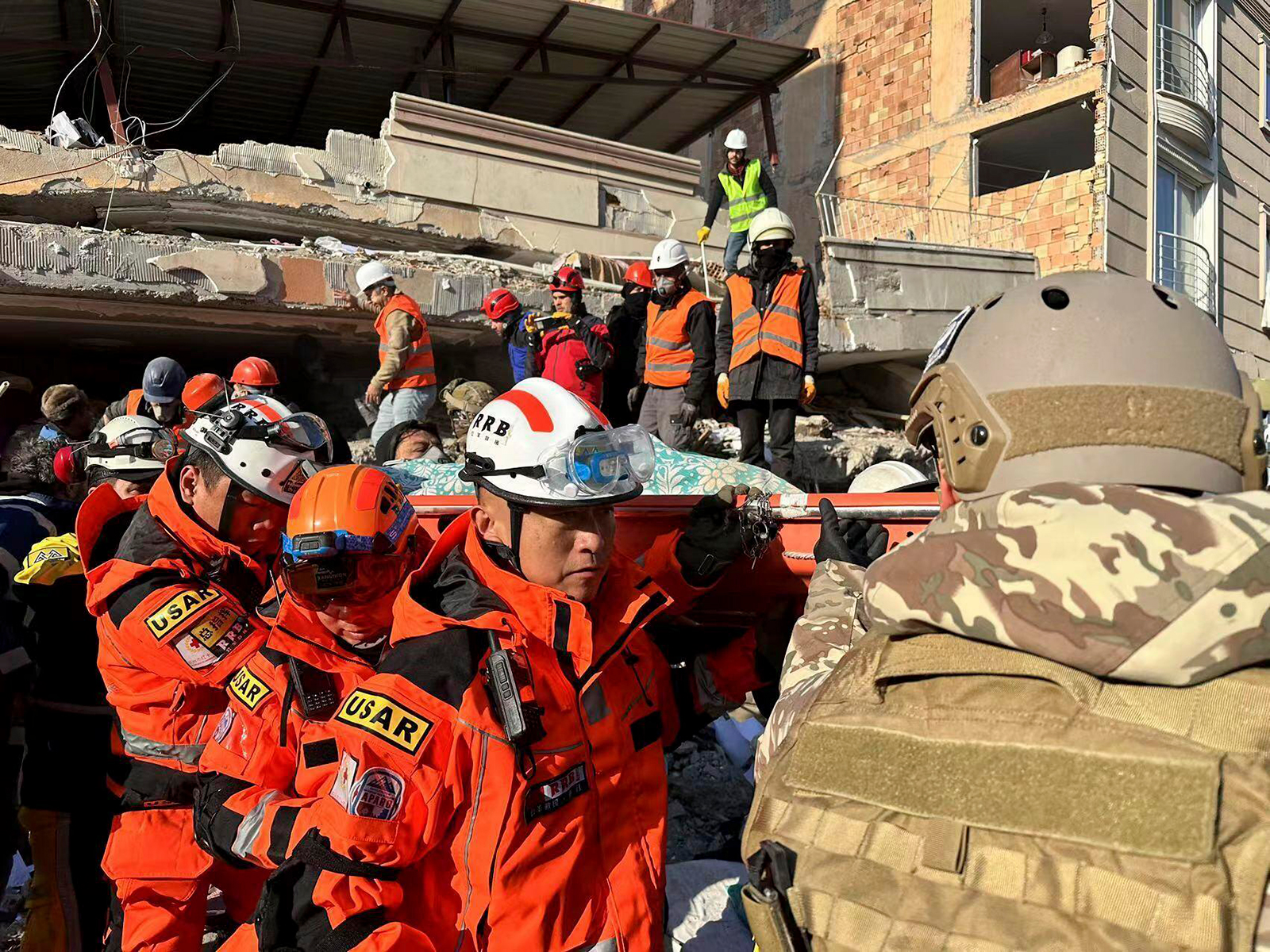
Earthquake survivors in Turkey's hard-hit coastal city of Iskenderun say they are losing hope of finding those still missing.
Server Onen said he had spent days searching for his friend under the wreckage of an apartment building in the southern city.
“The first day I was really hopeful but this is the fourth day, I am getting out of hope,” he told CNN.
Others, like Suheyl Sumbultepe, have been forced to accept their loved ones are gone.
Sumbultepe, who told CNN he saw his mother’s leg, said, “I’m not able to reach her. She is there. I see her but I cannot touch her. I understand my mother is dead. I am trying to get my mother.”
“Our government helps but it’s not enough, obviously. So we are trying to get our people by our own,” he said. “We need you. We need everyone who can come and help us.”
Some, like Burak Dik, have been successful in their efforts.
Dik said he flew from London to find his sister and other relatives, who were rescued from under the rubble after 15 hours. He told CNN it’s a miracle they made it out and likened the situation in Turkey to “a very bad dream.”
“I’m speechless to be honest,” Dik said. “My feelings are all collapsed. I’m only breathing at the moment.”
posted by Forhad @ February 10, 2023
0 Comments

Subscribe to
Posts [Atom]